

When designing medical devices, it’s important that manufacturers address patient safety, clinical needs and human error. As this field grows more technologically advanced and complex, addressing these concerns is increasingly challenging.
Health care manufacturers must closely examine industry trends and seek out high-quality materials when designing products — all while ensuring these devices comply with biocompatibility standards.
The process of die casting plays a sizeable role in medical device and equipment production. Explore the different medical-grade die casting materials and their uses.
What Is Die Casting?
Die casting is a manufacturing process that involves pouring molten metal into steel molds. These molds are constructed from hardened steel dies, which are specially designed for different projects. This allows manufacturers to create products more precisely and consistently.
Compared to other manufacturing methods, die casting provides significant savings in per-part costs, as well as overall production expenses. You can create one uniform product or combine multiple components into one part, minimizing assembly and labor costs.
Die casting provides several other advantages, such as:
- Minimal material scrap
- Variable wall thicknesses
- Fewer steps and fast production cycle times
- Long tool life
- Tighter tolerances
Die casting can create a wide variety of products, including locks, hooks, gears, door and pump handles, and so much more. Manufacturers can also use this innovative technique for medical equipment, instruments and devices.
These medical castings must be biocompatible. According to International Organization for Standardization (ISO) 10993, biocompatibility is the ability of a medical device to perform its desired function in a specific application.
Medical Casting Materials
Traditionally, medical manufacturers believed stainless steel was the only material that would meet Food and Drug Administration (FDA) approval for biocompatible medical device manufacturing. However, die casting surface treatment advancements now enable a wider range of specialized coatings and finishes that meet these rigorous testing standards.
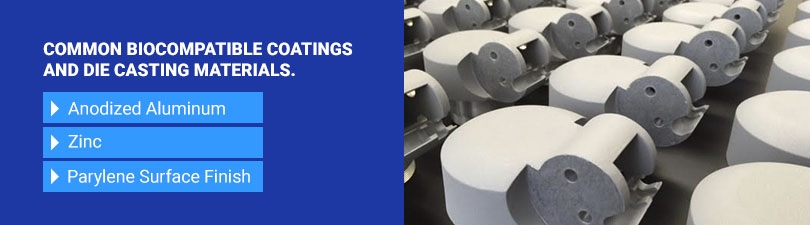
You don’t have to limit your options to one or two materials. Let’s look at some common biocompatible coatings and die casting materials.
1. Anodized Aluminum
Aluminum is favored for many external medical applications due to its relatively low manufacturing cost, weight-to-strength ratio, high degree of thermal conductivity and ability to be colored. Manufacturers can leverage aluminum’s benefits by using surface finishes for maximum biocompatibility.
Anodizing aluminum — the process of coating it with a protective oxide layer — is a critical first step in the medical industry, as it enables other necessary surface treatments. Anodizing also increases the aluminum’s strength and corrosion resistance. This process changes the metal’s surface into a porous aluminum oxide.
As a result, the product’s finish is more receptive to coloring and protective coatings, such as parylene. That means the medical equipment will meet biocompatibility regulations and last longer.
Some of the best aluminum alloys for medical die casting include:
- A360 aluminum: Albeit slightly more difficult to cast, A360 aluminum typically provides higher ductility and strength than A380. It’s well-suited to pressure-tight components and has a high silicon content. A360 also offers impressive corrosion resistance and strength at high temperatures.
- A380 aluminum: A380 aluminum boasts high electrical and thermal conductivity. It maintains dimensional stability, even with high temperatures and complex shapes. It’s lightweight and relatively corrosion-resistant. If you don’t need the highest levels of pressure tightness or corrosion resistance — and you have budgetary concerns to factor in — A380 is especially suitable.
- A383 aluminum: A383 aluminum alloy is another favorable option for die casters. It’s typically only used when creating intricate components and working with highly precise die-filling specifications. Some opt for A383 as an A380 alternative due to its enhanced ease of casting, corrosion resistance and dimensional stability. It may not share all of A380’s features, but it’s often more durable at high temperatures with a lower chance of cracking.
Though they exhibit different characteristics, these aluminum alloys provide impeccable corrosion resistance and strength-to-weight ratio. These attributes make them desirable for medical devices.
2. Zinc
Zinc allows manufacturers to design medical die cast instruments with precise tolerances and thin walls. With strong surface finishes and high cycle rates, this metal is substantial for complex shapes and medical parts requiring dimensional stability.
Its mechanical properties offer complex precision and near-net accuracy. Additionally, zinc alloy die castings offer considerable cost savings for medical device companies. Some other benefits of zinc die casting include:
- High corrosion resistance
- Easy to cast
- Good electrical and thermal conductivity
- Environmentally friendly and recyclable die castings
- Aesthetically appealing finishing characteristics
- Extended die life without regular maintenance requirements
3. Parylene Surface Finish
Medical manufacturers have used parylene as an equipment surface treatment for years. Protective and reliable, parylene biocompatibility conforms to ISO 10993 and U.S. Pharmacopeia (USP) Class VI regulations. It’s pin-hole free, transparent and accommodates virtually any surface’s features.
Parylene is known for its thin, consistent coating, offering coverage in even the most complex shapes — all while adding minimal volume and weight. These qualities make it an excellent coating for aluminum and zinc medical die castings. A parylene surface finish allows manufacturers to reap the benefits of die-casting — including cost savings, strength and accuracy — without compromising complexity.
Aside from meeting FDA biocompatibility guidelines, parylene is chemically inert with well-controlled thickness. It’s highly flake-resistant and can tolerate the effects of multiple sterilization procedures.
Medical Manufacturing Capabilities
From surgical devices to diagnostic and medical electronic equipment, biocompatible medical castings can assist various types of equipment and instruments. Let’s look at some medical die casting manufacturing capabilities associated with aluminum and zinc.
Aluminum Die Casting
Medical-grade aluminum has excellent shielding properties against electromagnetic interference (EMI) and radio frequency interference (RFI). This makes it a durable, high-performance option for various surgical instruments, including:
- Trays
- Stethoscopes
- Cases
- Tubes for diagnostic equipment
- Organizers and containers
Zinc Die Casting
Biocompatible and biodegradable, metallic zinc can be useful for temporary orthopedic implant parts like pins, screws and plates. Some other zinc die cast medical instruments include:
- Crutches
- Wheelchairs
- Seat lifts
- Stethoscopes
- General-purpose medical handles and panels
Request a Quote From Premier Die Casting Company
Offering over 70 years of expertise, Premier Die Casting is your source for aluminum die casting. We cater to a wide range of industries, including medical. From product designers to engineers and architects, we help a multitude of clients achieve their product visions and goals.
When you partner with our team, we’ll work with you to bring your designs to life, meeting your exact specifications and requirements. Committed to enhancing your products’ reliability, quality and function, our custom-made aluminum parts and outstanding service make us a top choice for high-quality die casting applications.
You can count on Premier for state-of-the-art equipment, extensive industry knowledge, highly trained staff and expert manufacturing. Contact us today to learn more about our services or request a free quote.